
What Are Meta Ads and How Do They Work? A Guide to Ads Manager Facebook
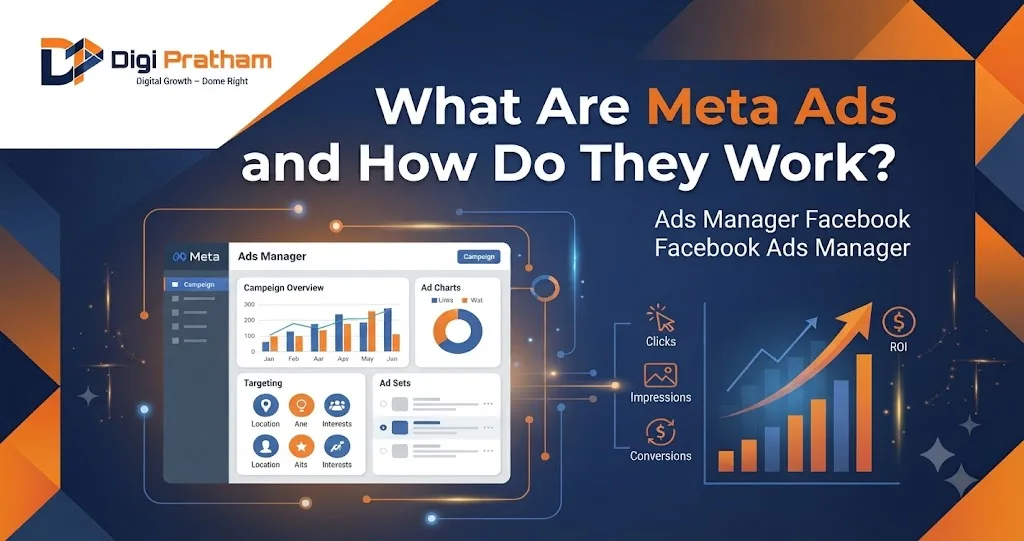
If you have ever been scrolling through Facebook or Instagram and noticed a post marked as sponsored, you have already encountered Meta Ads. Businesses use these paid advertisements to reach potential customers, promote products and services, generate leads, increase website visits, and support sales.
But how does the system actually decide who sees an advertisement? How does a business choose its audience? What determines where an advertisement appears, and how much does the advertiser pay?
This is where ads manager facebook becomes important.
Businesses can use Meta’s advertising platform to create campaigns, select objectives, define audiences, establish budgets, choose placements, publish advertisements, and monitor performance. Although many people still search for Facebook-specific advertising tools, Meta’s advertising ecosystem now covers both Facebook and Instagram.
Understanding what are meta ads and how do they work is therefore useful for anyone who wants to understand paid social media advertising.
In this guide, we will look at how Meta advertising works, how Meta Ads Manager is structured, how audiences and advertising auctions work, what different campaign components mean, and how businesses can approach paid advertising more effectively.
What Are Meta Ads?
Meta Ads are paid advertisements created through Meta’s advertising ecosystem. Businesses can use them to promote products, services, websites, offers, content, or other business objectives.
Unlike an organic social media post, a paid advertisement is created as part of a campaign with specific settings.
For example, an online store could create an advertisement to promote a new product. A local business might want to generate enquiries from people in a particular area. A service provider could use advertising to encourage potential customers to visit its website or submit a form.
A meta ad can use different creative formats, including images, videos, carousels, and other supported formats.
The fundamental idea is simple: instead of relying entirely on people discovering a business organically, the business pays to participate in Meta’s advertising system and reach selected audiences.
However, successful advertising involves much more than simply paying to display an advertisement. Businesses need to consider their objective, audience, offer, creative, budget, destination, and measurement strategy.
How Does Ads Manager Facebook Work?
For someone learning ads manager facebook, the platform can initially seem complicated because it brings several advertising functions together.
At a basic level, the process works like this:
- Choose what the campaign should achieve.
- Define the audience you want to reach.
- Set a budget and schedule.
- Select suitable placements.
- Create the advertisement.
- Publish the campaign.
- Monitor performance.
- Analyze the results.
- Make informed adjustments.
The advertiser controls important strategic decisions, while Meta’s advertising system handles the delivery process.
This distinction is important. Using ads manager facebook does not mean manually deciding which individual person will see every advertisement. Instead, the advertiser provides campaign parameters and the system uses those inputs to determine delivery among eligible advertising opportunities.
What Is Meta Ads Manager?
Meta Ads Manager is the platform used by advertisers to create, manage, monitor, and analyze Meta advertising campaigns.
You may also encounter terms such as fb ad manager, Facebook Ads Manager, or ads manager facebook when searching for information about the platform.
The terminology can be confusing because Facebook was historically the primary platform associated with these advertising tools. Meta’s advertising ecosystem has since expanded to include advertising across Facebook and Instagram.
Meta Ads Manager organizes campaigns into three primary levels:
Campaign
The campaign is the highest level of the structure.
This is where the overall advertising objective is established. The objective should reflect what the business actually wants to accomplish.
For example, a campaign could be designed around awareness, traffic, engagement, leads, sales, or another supported business outcome.
Ad Set
The ad set contains important delivery settings.
Depending on the campaign, these may include audience, budget, schedule, placements, and optimization-related settings.
A campaign can contain multiple ad sets when an advertiser wants to test different audiences or approaches.
Ad
The ad is the actual promotional content that people see.
It can contain an image or video, primary text, headline, call-to-action, and other components depending on the selected format.
Understanding this three-level structure makes ads manager facebook much easier to understand because each level has a different role.
How Does Ads Manager Facebook Decide Where Ads Appear?
Once a campaign is published, the advertisement does not simply appear in front of random users.
Meta’s advertising system identifies eligible advertising opportunities and uses an auction-based delivery process to determine which advertisements are shown.
The advertiser can select or allow certain placements depending on the campaign configuration. These can include different locations across Facebook and Instagram.
For example, an advertisement may be eligible for a Facebook feed placement or an Instagram placement.
The creative should therefore be designed with the intended placement in mind.
An image that looks good in a feed may not necessarily work equally well in a vertical Stories environment.
This is one reason campaign management through ads manager facebook involves more than uploading one image and pressing publish.
How Does the Meta Advertising Auction Work?
A key part of understanding what are meta ads and how do they work is understanding the advertising auction.
When an advertising opportunity becomes available, eligible advertisements can compete for that opportunity.
The system considers multiple factors when determining which advertisement is delivered. The advertiser’s budget or bid-related settings are therefore not the only considerations.
This means that simply increasing advertising expenditure does not automatically guarantee better results.
Consider two businesses advertising similar services.
One may have a well-defined audience, relevant creative, a strong offer, and a useful landing page. Another may spend more money but use a weak message and poorly aligned audience.
The amount spent alone cannot explain the effectiveness of either campaign.
For advertisers, the practical lesson is that campaign strategy, creative relevance, audience selection, and the overall customer journey matter alongside budget.
How Does Audience Targeting Work in Meta Ads?
Audience targeting is one of the most important parts of social media advertising.
Businesses can use available targeting tools to define the types of people they want to reach.
Depending on the campaign and available options, audience decisions can involve factors such as:
- Location
- Demographic characteristics
- Interests
- Behaviours
- Previous interactions
- Website activity
- Customer or business data
Businesses can also think about audiences according to their relationship with the brand.
Someone who has never heard of a company may require different messaging from someone who has already visited its website.
For example, a business might have one audience consisting of potential new customers and another consisting of people who previously interacted with its content.
This allows advertising strategies to address different stages of the customer journey.
However, targeting should not automatically become as narrow as possible. A highly restrictive audience is not necessarily better simply because it appears more specific.
The audience should be relevant to the business while providing the advertising system with an appropriate opportunity to deliver the campaign.
Campaigns, Ad Sets and Ads in Ads Manager Facebook
Understanding the structure of ads manager facebook becomes especially useful when a business wants to test different advertising ideas.
Imagine a company wants to promote a website design service.
At the campaign level, it establishes its overall objective.
At the ad-set level, it can work with different audience or delivery configurations.
At the ad level, it can test different creative concepts.
For example, the company could test one advertisement focused on website performance and another focused on professional appearance.
If the other campaign conditions are appropriately controlled, the resulting data can provide useful information about how audiences respond to the different messages.
This structured approach is more informative than changing the audience, budget, creative, and objective simultaneously.
What Role Does Creative Play in Meta Ads?
Creative is the part of the advertisement that users actually experience.
It can include:
- Images
- Videos
- Carousels
- Primary text
- Headlines
- Calls to action
Even excellent targeting cannot compensate for an advertisement that fails to communicate its value.
Imagine a business offering digital marketing services.
A generic fb ad saying “Grow Your Business Today” may give people very little information.
A more specific advertisement could identify a problem, explain a relevant benefit, and give the viewer a clear reason to take the next step.
This does not mean that every advertisement needs lengthy copy. The important consideration is whether the creative communicates the intended message clearly to the intended audience.
Testing different creative concepts can therefore be an important part of campaign optimization.
How Do Facebook Ads and Instagram Ads Work Together?
Facebook and Instagram are both part of Meta’s advertising ecosystem.
This means businesses can often manage campaigns intended for both platforms through Meta’s advertising tools, depending on campaign settings and placement eligibility.
Someone searching for ads instagram may therefore encounter many of the same campaign concepts used for Facebook advertising.
However, the user experience can differ between platforms and placements.
For example, a creative designed for a Facebook feed may not be ideal for an Instagram Story.
Businesses should consider the environment in which people will see their advertisements and ensure that the creative works appropriately within that environment.
The objective is not necessarily to create completely different campaigns for every placement. Instead, advertisers should understand how the same campaign may be experienced in different contexts.
What Is Instagram Advertising?
Instagram advertising is paid promotion delivered through Instagram as part of Meta’s advertising ecosystem.
Businesses can use Instagram advertising to promote products, services, content, offers, or other business objectives.
Instagram’s highly visual environment makes creative presentation particularly important.
For example:
- A clothing brand may showcase products through lifestyle photography.
- A restaurant may use food photography or short videos.
- A service business may use educational videos.
- An online store may demonstrate how a product works.
The most appropriate creative depends on the audience and the business objective.
Therefore, businesses should not use Instagram advertising simply because Instagram is popular. They should consider whether the platform’s audience and advertising environment align with their marketing objectives.
What Objectives Can Businesses Choose?
Before creating an advertisement, a business should determine what it actually wants to accomplish.
Depending on the available campaign setup, Meta provides advertising objectives related to different business outcomes.
Awareness
An awareness-focused campaign can help introduce a brand, product, or service to potential audiences.
Traffic
Traffic campaigns can be used when the objective is to encourage people to visit a website, landing page, or another destination.
Engagement
Engagement-oriented campaigns can encourage interactions with content or other supported actions.
Leads
Lead campaigns can be useful for businesses that depend on enquiries, registrations, consultations, or similar actions.
Sales
Sales-focused campaigns can be used by businesses seeking purchases or other valuable conversion actions.
The important point is that the campaign objective should match the business goal.
A company seeking enquiries should not automatically judge success by the number of impressions alone.
How Does Ads Manager Facebook Handle Budgeting?
Budget determines how much a business is prepared to spend on advertising according to its chosen campaign and budget settings.
There is no single advertising budget that works for every business.
A local business with a limited service area may have a very different budget from a national e-commerce company.
What matters is the relationship between expenditure and meaningful business outcomes.
For example, spending ₹3,000 and generating several qualified enquiries may be more useful to a service business than spending ₹10,000 and generating large numbers of low-value interactions.
Therefore, businesses should evaluate advertising expenditure alongside the results that actually matter to them.
Which Meta Ads Metrics Should Businesses Track?
The appropriate metrics depend on the campaign objective.
Some commonly used measurements include:
Reach
Reach represents the number of people who were shown the advertisement.
Impressions
Impressions represent the number of times an advertisement was displayed.
Click-Through Rate
CTR measures the percentage of impressions that resulted in clicks.
Cost Per Click
CPC indicates the average cost associated with clicks.
Cost Per Result
This helps businesses understand the average amount spent to achieve the selected campaign result.
Conversion Rate
Conversion rate measures how frequently people complete a desired action after reaching the relevant destination or taking the relevant step.
Return on Ad Spend
ROAS compares attributed revenue with advertising expenditure when appropriate conversion tracking is available.
Businesses should avoid judging a campaign using a single metric without considering its actual objective.
A campaign can generate many clicks without generating meaningful enquiries or sales.
Common Mistakes When Using Ads Manager Facebook
Learning ads manager facebook is only one part of running advertising campaigns. Businesses also need to understand common strategic mistakes.
Choosing an Objective Without a Clear Goal
If the business does not know what it wants the campaign to achieve, it becomes difficult to evaluate performance.
Using Generic Advertising Messages
A vague message may fail to explain why the audience should pay attention.
Changing Too Many Things at Once
If an advertiser changes the audience, creative, budget, and campaign settings simultaneously, identifying the cause of performance changes becomes more difficult.
Ignoring the Landing Page
A good advertisement can generate website visits, but a poor landing-page experience can prevent those visitors from becoming customers.
Focusing Only on Cheap Clicks
A low CPC does not automatically mean that a campaign is producing valuable business results.
Treating Every Customer the Same
A first-time prospect and an existing customer may require different communication.
Advertising should reflect where appropriate the audience’s relationship with the business.
How Can Businesses Improve Their Meta Ads?
Improvement should be based on evidence rather than assumptions.
Businesses can review performance and examine the relationship between audience, creative, offer, landing page, and business results.
Testing can then be used to learn what works better for a particular campaign.
Advertisers may test:
- Different images
- Different videos
- Headlines
- Primary text
- Offers
- Calls to action
- Audiences
- Landing pages
The important principle is to test systematically.
Changing everything at once can make the results difficult to interpret.
Businesses should also avoid making conclusions from extremely limited information. Campaign data needs to be considered in context, including the objective, market, budget, audience, and customer journey.
Why Can Meta Ads Be Useful for Small Businesses?
Small businesses often have limited marketing resources and need to think carefully about where they spend their promotional budget.
Meta advertising provides tools that can help businesses reach defined audiences, control advertising expenditure, measure campaign activity, and make adjustments based on performance information.
A local service business, for example, may need to focus on people in specific locations. An online business may have customers across several regions.
However, advertising is not a replacement for a strong product, service, offer, website, or customer experience.
A paid campaign can bring attention to a business, but the business still needs to give potential customers a convincing reason to take the next step.
How Digi Pratham Approaches Meta Advertising ?
At Digi Pratham, Meta advertising can be considered as one part of a broader digital marketing strategy.
Instead of treating an advertisement as an isolated piece of content, the campaign can be evaluated alongside the target audience, business objective, creative, landing page, conversion journey, and available performance data.
Understanding ads manager facebook is useful because the platform provides the controls needed to manage campaigns. However, knowing how to use those controls is different from developing a strategy around them.
A business should understand who it wants to reach, what it wants those people to do, what value it is offering, and how success will be measured.
This creates a more structured foundation for using paid social media advertising.
Frequently Asked Questions About Ads Manager Facebook and Meta Ads
What are Meta Ads?
Meta Ads are paid advertisements created through Meta’s advertising ecosystem. Businesses can use them to promote products, services, content, websites, offers, or other business objectives across eligible placements.
What is Ads Manager Facebook used for?
Ads manager facebook is a commonly searched term for the advertising management platform associated with Facebook and Meta. It is used to create campaigns, manage audiences and budgets, configure advertisements, and analyze campaign performance.
Is FB Ad Manager the same as Meta Ads Manager?
The terminology has evolved as Meta’s advertising ecosystem has expanded. People may still use fb ad manager or Facebook Ads Manager when referring to advertising tools, while Meta Ads Manager represents the broader current ecosystem.
Can I advertise on Facebook and Instagram together?
Meta’s advertising tools can allow businesses to use Facebook and Instagram placements within campaigns, depending on the campaign configuration and available placements.
What is the difference between a Meta Ad and an organic post?
An organic post is published without paying specifically for advertising distribution. A Meta Ad is created as part of a paid campaign and delivered through Meta’s advertising system.
How much does Meta advertising cost?
There is no universal fixed price. Costs can vary depending on factors such as audience, competition, campaign objective, creative, market, budget, and delivery.
Do Meta Ads guarantee sales?
No. Advertising can help businesses reach potential customers, but sales also depend on factors such as the offer, audience, creative, landing page, customer experience, competition, and sales process.
Final Thoughts
Understanding what are meta ads and how do they work means looking at more than the advertisement itself.
A Meta advertising campaign involves an objective, audience, budget, creative, placements, delivery system, and performance measurement.
Ads manager facebook provides the tools businesses use to manage many of these elements, while Meta’s advertising system handles the auction and delivery processes involved in showing eligible advertisements.
Facebook advertising and Instagram advertising can therefore form part of a broader digital marketing strategy when campaigns are built around clear objectives and relevant audiences.
For businesses, the goal should not simply be to spend more money or generate more impressions. The focus should be on understanding the relationship between advertising activity and meaningful business outcomes.
Whether you are learning Meta Ads Manager for the first time or already managing campaigns, understanding the fundamentals gives you a stronger foundation for making informed advertising decisions.